AvaritCall · Editorial team
AI call center cost in 2026: per-minute prices and hidden line items
The real cost of an AI call center across four common pricing models (component-based, plan + minutes, contract-based, per-minute pay as you go), the STT+LLM+TTS+telephony formula and 1,000/10,000-minute scenarios, with AvaritCall's $0.08 per-minute price in the comparison (accessed 30 August 2026).

Pricing pages for AI call centers usually put one number up front: the per-minute rate. Yet that number is often only the platform's own share; speech-to-text (STT), the language model (LLM), text-to-speech (TTS), the phone line, concurrent-call capacity, number rental and add-ons are billed on separate lines. This article uses vendors' own pricing pages, opened on 30 August 2026, to show how the total is built under four common pricing models and how the formula plays out in two monthly scenarios of 1,000 and 10,000 minutes. We do not name vendors; every figure is referred to by pricing model and source number.
How much does an AI call center cost?
Short answer: the advertised per-minute rate and the amount you pay are different things. The pricing page of a component-based US platform quotes "$0.07–$0.31/min" for voice agents; the range depends on voice infrastructure, the TTS voice and the LLM model [1]. The worked example on the same page reaches $0.11/min with LLM $0.04 + voice infra $0.055 + TTS $0.015; telephony (via a US carrier) at $0.015/min comes on top [1]. The gap comes from component choices and separately billed items.
The general rule: Total cost = (platform + STT + LLM + TTS + telephony) × talk minutes + fixed monthly items (number, extra concurrency lines, plan fee, compliance add-ons). The question to ask is not "how much per minute?" but "which components are inside that number, and which are outside?"
How much does an AI phone assistant cost per minute?
The line items of one minute of conversation, from pages dated 30 August 2026:
- Speech recognition (STT): A speech-recognition provider's pay-as-you-go page lists its streaming model at $0.0077/min, the multilingual version at $0.0092/min (discounted current prices $0.0048 and $0.0058) [2].
- Language model (LLM): The most variable item. On the component-based US platform it runs from the smallest model at $0.003/min up to the most expensive model at $0.32/min depending on the choice; for example a lightweight model $0.025, the same provider's standard flagship model $0.16, a third LLM provider's models $0.006–$0.081; the mid-range model in the worked example $0.04/min [1].
- Speech synthesis (TTS): On the same platform, platform voices and two voice providers' voices cost $0.015/min; a premium-positioned voice provider's voices $0.040/min [1]. Voice choice alone can add $0.025 to the minute.
- Telephony (carrier): A US carrier's US page lists local outbound at $0.0140/min, inbound at $0.0085/min, a local number at $1.15/mo; with your own SIP trunk (BYOC) $0.0040/min [3]. The same carrier's Turkey page lists the per-minute rate for outbound calls to Turkey: $0.0701/min to landlines and $0.2875/min to mobiles [4].
- Platform/orchestration: A second component-based platform that lets you bring your own API keys charges a $0.05/min platform fee; STT/LLM/TTS are passed through "at cost", $0 with your own keys; "transport" is billed separately by the provider [5]. On the first platform the same item is called "voice infra" at $0.055/min [1].
- Concurrency: The first platform gives the first 20 concurrent calls free, then $8 per concurrent line per month [1]; the second includes 10 lines, extra lines $10/mo [5].
- Numbers and add-ons: On the first platform a number is $2/mo, a verified number $10/mo; PII removal +$0.01/min, advanced denoising +$0.005/min, an AI quality-assurance add-on free for the first 100 minutes then $0.10/min, knowledge bases free for the first 10 then $8/mo plus +$0.005/min in use [1].
- Compliance add-ons: On the second platform, the HIPAA add-on is $2,000/mo and zero data retention $1,000/mo; the mid tier keeps call history for 14 days [5].
Add these up and a headline figure like "$0.05/min" lands at $0.12–0.13/min with a mid-range model and a standard voice. If the page lists one item, you have to ask what is left out (usually telephony); on AvaritCall the $0.08 includes STT, LLM and TTS, there is no number or line fee, the line's call charges are billed by your carrier, and reports, IVR and VAT are extra.
AI voice agent pricing comparison 2026
The summary comes from the vendors' own pricing pages (30 August 2026); no third-party estimates. Vendors are referred to by pricing model and the source number in square brackets, not by name.
- A component-based US platform: $0.07–$0.31/min; components add up (voice infra $0.055 + TTS $0.015–0.040 + LLM $0.003–0.32); telephony separate, $0.015/min via a US carrier; number $2/mo and concurrency beyond 20 lines $8/line/mo separate; $10 starting credit [1]. At least four separate lines add up on the invoice.
- A second component-based platform that lets you bring your own API keys: $0.05/min platform + STT/LLM/TTS at cost ($0 with your own keys); 10 concurrency included, extra line $10/mo; carrier billed separately and not named on the page; HIPAA $2,000/mo, zero data retention $1,000/mo [5]. The platform fee alone is $0.05; models and telephony come on top.
- A platform selling on a plan + minutes model: entry plan $0.14/min ($0 platform fee, 10 concurrent, 100 calls/day), mid plan $0.12/min ($299/mo, 50 concurrent, 2,000 calls/day), top plan $0.11/min ($499/mo, 100 concurrent, 5,000 calls/day); LLM+STT+TTS included, telephony separate (your own carrier/SIP or the platform's partner carrier with the charge passed through at cost); transfers $0.05/$0.04/$0.03 per min [6]. Exceed the daily call cap and you move up a plan; base fee $299–499 per month.
- An enterprise provider selling on contracts starting at $30,000 a year: enterprise contracts only; no per-minute rate published; its own native telephony, SIP trunking or approved enterprise telephony; EU and US hosting [7]. No self-service; a quote and an annual commitment are required.
- A provider that does not publish its price: "per-minute" pricing said to include maintenance and 24/7 support; no figure [8]. No self-service sign-up; a demo and a quote are required.
There are four structures: component-based sums (the first two platforms), plan + minutes (the third), contract-based (the last two) and per-minute pay as you go (AvaritCall); in the second you move up a plan once you exceed its limits, in the third there is no number without a quote, in the fourth there are no separate lines for speech recognition, model and voice.
The 1,000 and 10,000-minute scenarios: formula and assumptions
Formula: Monthly cost = minutes × (platform + STT + LLM + TTS + telephony) + number + extra concurrency + plan fee. Assumptions: US domestic outbound calls, mid-range LLM, standard TTS, 3-minute average call, at most 10 concurrent calls, no compliance add-ons, taxes excluded. All prices in this article are exclusive of tax.
- The first component-based platform: the page's example $0.11 + telephony $0.015 = $0.125/min; number $2/mo [1]. 1,000 min ≈ $127; 10,000 min ≈ $1,252.
- The second, bring-your-own-keys component-based platform: platform $0.05 [5] + STT $0.0077 (the speech-recognition provider's own list price; the amount the platform passes through may differ) [2] + LLM $0.04 and TTS $0.015 (the first platform's example, as a proxy value) [1] + telephony $0.014 (US carrier, US domestic outbound) [3] ≈ $0.127/min; number $1.15/mo [3]. 1,000 min ≈ $128; 10,000 min ≈ $1,268.
- The plan + minutes model: 1,000 min (≈333 calls/mo) fits the entry plan: 1,000 × ($0.14 + $0.014) ≈ $154; the entry plan includes an inbound number [6][3]. 10,000 min means ≈3,333 calls/mo; that exceeds the entry plan's 100 calls/day cap, so the mid plan with its $299/mo base fee is required: $299 + 10,000 × ($0.12 + $0.014) ≈ $1,639 [6][3].
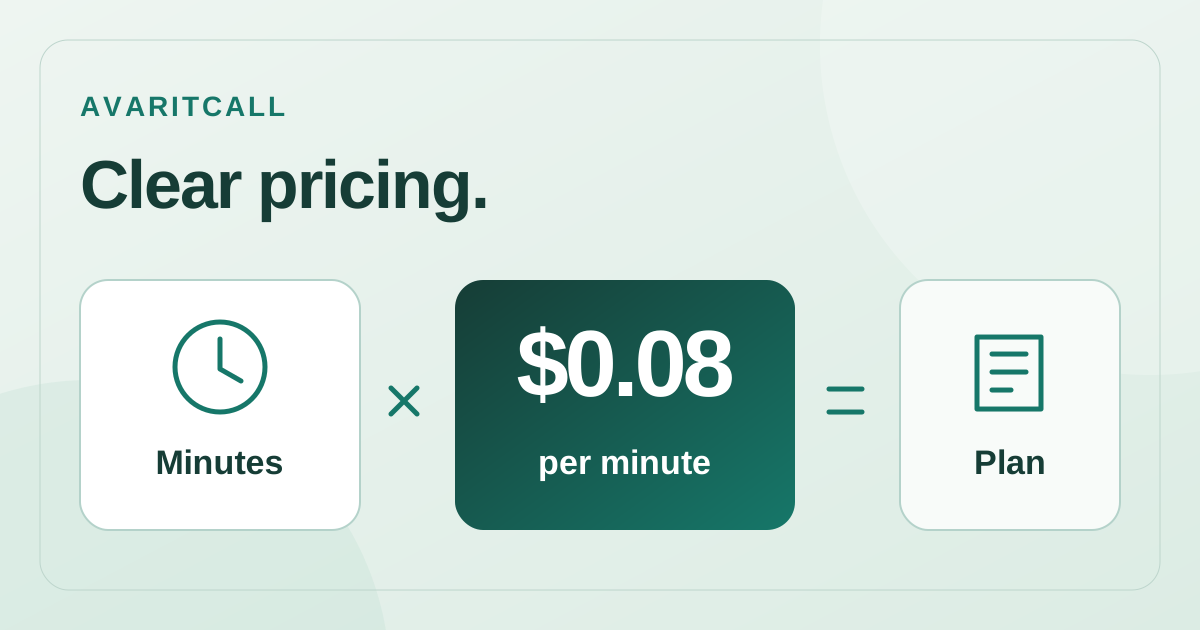
- AvaritCall: 1,000 min ≈ $80; 10,000 min ≈ $800. A talk minute costs $0.08 including STT+LLM+TTS; there is no number or line fee (the line's call charges are with your carrier), no base fee, no commitment [9]. At the same volume that is 1.5–2 times below the three platforms above at $127–154 and $1,252–1,639.
- The two contract-based providers: cannot be calculated without a published per-minute rate; the enterprise one has a floor of $30,000 a year [7].
For the same 10,000 minutes the results on the three platforms that bill telephony separately range from $1,252 to $1,639; most of the gap comes not from the per-minute rate but from secondary items such as plan thresholds and telephony. On AvaritCall the same volume is $800; with no base fee and no separate telephony line there are no secondary items to add. If you call Turkish mobiles, the carrier item alone is $0.2875/min on the US carrier [4]; on platforms that bill telephony separately it becomes the largest part of the total and the local SIP trunk rate becomes the deciding factor.
AvaritCall's structure is the opposite of that table: speech recognition, model and voice in one minute rate. Pricing is pay as you go: a talk minute costs $0.08 (STT, LLM and TTS included; reports, IVR and VAT extra), $5 credit on sign-up, $10 minimum top-up, no commitment, no base fee (avaritcall.com/en/pricing) [9]. According to the vendor, the $0.08 also covers its self-developed telephony software: codec management including Opus, echo cancellation, channel and concurrency management, SIP trunk and DID support; there is no number or line fee, and the line's call charges are billed by your carrier [9]. Only talk minutes are billed; no audio is recorded, only the text transcript is kept; a built-in CRM, a REST API with webhooks, multilingual conversation support and Turkish voices trained in-house are part of the platform. Add-ons are separate and small: e-mail report $0.001, WhatsApp report $0.005 each, IVR voice generation $0.15 per 1,000 characters [9]. What adds up across four or five lines on the platforms above is one line here; at 10,000 minutes, $800 sits 1.5–2 times below the $1,252–1,639 of the platforms that bill telephony separately.
If you see a single number on a pricing page, you have to add up the remaining items yourself.
Is an AI call center cheaper than a human operator?
There is no single answer; let's go with sourced numbers. According to the Turkish Ministry of Labour and Social Security's calculation for 1 January–31 December 2026, the monthly gross minimum wage in Turkey is TL 33,030.00, net TL 28,075.50; the total cost to the employer in non-manufacturing sectors is TL 40,214.03 (including the 2-point SGK premium discount; TL 40,874.63 without it) [10]. At the Central Bank of Turkey's buying rate of 48.0732 TL/$ dated 28 August 2026, that cost is roughly $837/month [11].
To turn this into a per-minute cost you need to know how many minutes an operator actually talks per month; that depends on the sector and occupancy, and we give no unsourced average. A bound calculation: an operator who talks 10,000 minutes in a month costs ≈ $0.084/min; at 5,000 minutes ≈ $0.167 (TL 40,214.03 ÷ 48.0732 ÷ minutes) [10][11]. Given that 10,000 minutes came out at $1,252–1,639 on the platforms that bill telephony separately and at $800 on AvaritCall (your carrier's line charges excluded), a single operator at minimum-wage level and high occupancy is in the same order of magnitude as AvaritCall; the difference shows up in night/weekend coverage, concurrent calls and the fact that minutes not spent talking are not billed. We left out items with no sourced figure, such as hiring, training and management (human) and setup, integration and a handoff team (AI). For ways to lower call center costs, see our separate article: avaritcall.com/en/blog/cagri-merkezi-maliyetini-dusurmek.
Six cases where the math does not add up
- Very low volume: For a few hundred minutes a month, fixed items outweigh the per-minute rate; the $299/mo base fee of the plan + minutes model [6] and the enterprise provider's $30,000 annual floor [7] make no sense at that scale. AvaritCall has no base fee; the $5 sign-up credit covers roughly 60 minutes, and 100 minutes cost $8.
- Sectors that require certifications: HIPAA/SOC 2-type statements are paid add-ons on some platforms (HIPAA $2,000/mo on one platform [5]); with providers that publish such statements, telephony is billed separately and base-fee plans come into play [6], or the statement comes only with a contract starting at $30,000 a year [7]. AvaritCall's approach rests on data minimisation rather than certification badges: no audio is recorded, only the text transcript is kept; it operates in compliance with KVKK and GDPR. If a tender names a specific certification, ask about it at the quote stage.
- Emergencies and final decisions: An AI agent is not designed to replace emergency lines; decisions with legal, medical or financial consequences must be handed to a human.
- Noisy environments: Recognition accuracy drops; noise-suppression add-ons may cost extra (+$0.005/min on the component-based platform [1]). On AvaritCall echo cancellation is part of the telephony layer, not a paid add-on.
- Calls to Turkish mobiles: If the cost via the US carrier is around $0.2875/min [4], optimizing the AI items (STT/LLM/TTS) changes little in the total; solve the telephony route first. AvaritCall's own telephony software (SIP trunk and DID support) is, according to the vendor, included in the per-minute price; there is no number or line fee, and the line's call charges are billed by your carrier.
- Very high concurrency: Every platform requires extra lines or an enterprise package; on AvaritCall channel and concurrency management happens in its own telephony layer; ask about very high concurrency at the quote stage.
Three questions are enough when reading a pricing page: Which components does the per-minute rate cover? What are the fixed monthly items and plan thresholds? Who bills telephony, and at which country's tariff? This article is not legal or financial advice; prices, exchange rates and regulations may change; all sources were accessed on 30 August 2026.
- [1]Retell AI Pricing — Retell AI (accessed: 2026-08-30)
- [2]Deepgram Pricing — Deepgram (accessed: 2026-08-30)
- [3]Twilio Voice Pricing – United States — Twilio (accessed: 2026-08-30)
- [4]Twilio Voice Pricing – Turkey (outbound calls) — Twilio (accessed: 2026-08-30)
- [5]Vapi Pricing — Vapi (accessed: 2026-08-30)
- [6]Bland AI Pricing — Bland AI (accessed: 2026-08-30)
- [7]Synthflow Pricing — Synthflow (accessed: 2026-08-30)
- [8]PolyAI Pricing — PolyAI (accessed: 2026-08-30)
- [9]AvaritCall fiyatlandırma — AvaritCall (üretici sayfası) (accessed: 2026-08-30)
- [10]Asgari Ücretin Net Hesabı ve İşverene Maliyeti (2026) — T.C. Çalışma ve Sosyal Güvenlik Bakanlığı, 2026-01-01 (accessed: 2026-08-30)
- [11]TCMB Gösterge Niteliğindeki Kurlar – 28.08.2026 (Bülten 2026/161) — Türkiye Cumhuriyet Merkez Bankası, 2026-08-28 (accessed: 2026-08-30)