AvaritCall · Editorial team
AI phone assistant for real estate offices: which calls it takes over and how to set it up
Listing enquiries, viewing appointments and missed calls: the phone reality of a real estate office. A response-speed study points to the importance of the first minutes; six call types an AI assistant can take over, what it should not handle, and the setup steps.

A real estate office's phone rings with the same handful of questions for most of the day: "Is the flat in the listing still for sale?", "What are the monthly building fees?", "Can you show it this weekend?", "I have a shop to rent out, would you take it into your portfolio?" Most of these calls arrive while the agent is in the field, at a viewing or on another call. A call that goes unanswered is rarely repeated; the caller tries the next office on the list.
The volume is not small. According to TurkStat (Turkish Statistical Institute) data, 1,688,910 homes were sold in Türkiye in 2025, a 14.3% increase on the previous year, and 1,148,124 of those sales were second-hand homes [1]. In the first seven months of 2026, 823,119 homes changed hands; although sales in July 2026 fell 17% year on year, second-hand homes kept a 65.6% share [2]. Behind every sale there are dozens of listing enquiries, viewings and call-backs; in a market dominated by second-hand homes, most of that traffic runs through real estate office phones.
The first five minutes: what does one vendor study say about response speed?
The most-cited study on lead response speed is the Lead Response Management study that InsideSales.com ran with Prof. Oldroyd of MIT. It examined three years of data from six companies, more than 15,000 leads and over 100,000 call attempts, and found that when a lead is contacted within 30 minutes instead of 5, the odds of qualifying them fall 21-fold; the study puts the effect of fast response on contact rates at 100-fold. According to the same study, contact success drops more than tenfold within the first hour alone [3]. The study is not a peer-reviewed publication but undated research by a sales-software vendor (the page carries no publication date); it is nevertheless used as the industry's baseline reference.
This data comes from non-real-estate sectors and web-form leads; transferring the ratios one-to-one to a real estate office would be wrong. The direction, however, is especially meaningful for real estate. Agent representation dominates the US market. According to the US National Association of Realtors (NAR) 2025 profile survey, which covers July 2024–June 2025 and was answered by 6,103 primary-residence buyers, 88% of buyers purchased their home through an agent or broker, and 91% of sellers worked with an agent [4]. We could not find a comparable data set for Türkiye; still, the finding that first-contact speed is decisive [3] explains the cost of every missed call.
Can AI answer incoming calls at a real estate office?
Yes — but not "all calls", only defined call types. A properly configured voice assistant listens to the caller, answers from the knowledge base, collects the necessary information and passes the result to the agent. Six call types that can be taken over in a real estate office:
- Listing information questions: relaying price, square metres, floor, building fees, heating type, title deed status and other details the office has entered into its knowledge base, from the portfolio record matched by listing number or description ("the 3+1 in Kadıköy", i.e. three rooms plus a living room).
- Viewing appointments: offering available slots from the agent's calendar, creating the appointment, sending the confirmation via WhatsApp or SMS and reminding the caller a day before.
- Pre-qualification: collecting budget, preferred district and neighbourhood, number of rooms, moving timeline and whether a mortgage will be used from buyers or tenants.
- Portfolio intake: taking location, property type, expected price and contact details from an owner who says "I have a flat to sell" and leaving a note for the agent to arrange an authorisation meeting.
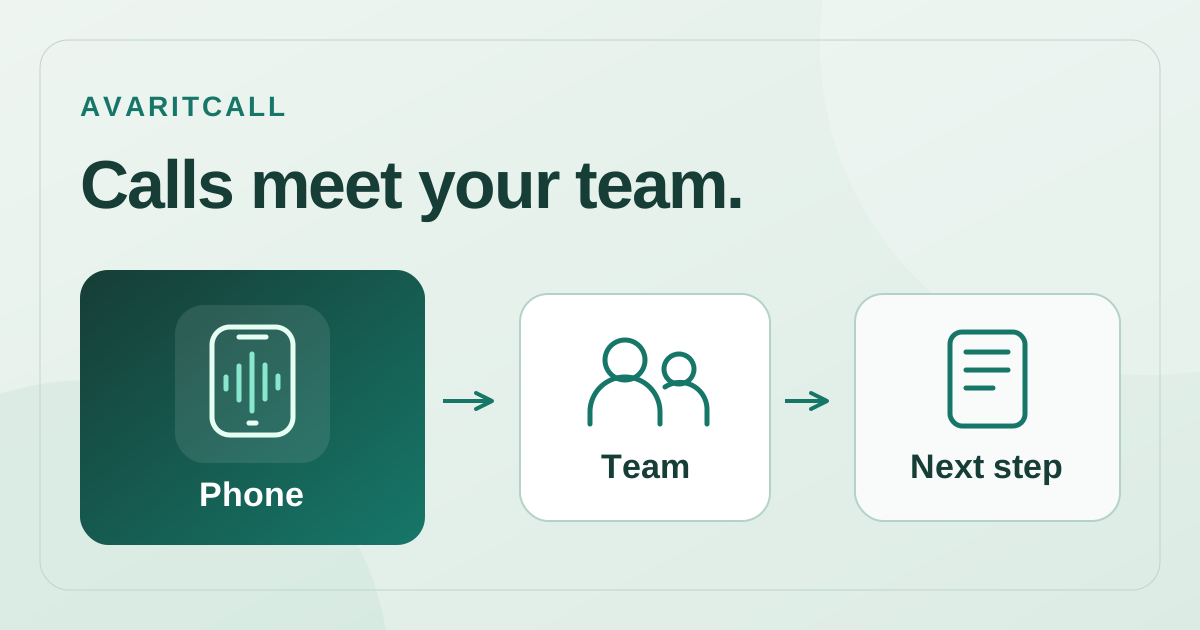
- Call-back promises: when the agent is busy, taking the caller's name, number and topic, stating a time window for the call-back and passing that promise to the team as a task.
- After-hours calls: answering evening and weekend calls so that the next morning the agent has a "who, why, which listing" summary ready.
The common thread: in none of these calls does the assistant make a decision; it informs, collects and hands over. Closing, negotiation and the relationship stay with the agent.
Can AI qualify real estate leads?
Qualification means telling whether a caller is a genuine buyer or merely price-checking. A voice assistant does this in conversation rather than like a form: "What is your budget range?", "Only Ataşehir, or would neighbouring districts work?", "When are you planning to move?", "Are you considering a mortgage?" The answers are written to the CRM as structured fields; when the agent looks at the list, they see a line such as "3+1, 8–10 million TL, Çankaya, within two months, with mortgage". This makes it easier to choose which of the morning's dozens of missed calls to return first.
The limit must be stated just as clearly: the assistant records what it is told, it does not verify it. Mortgage eligibility, real purchasing power or a seller's price flexibility are not matters that get resolved over the phone. Qualification does not finish the agent's job; it clarifies which conversation deserves their time. One more distinction: returning an incoming call (the customer's own request) is different from calling a cold list; the latter counts as a commercial electronic message for marketing purposes and requires İYS consent, Türkiye's opt-in registry (details: avaritcall.com/tr/blog/yapay-zeka-ile-giden-arama-kampanyasi-yasal-cerceve).
The job of the assistant that answers the phone is not to sell, but to avoid losing the caller and to hand over to the agent with the right information.
Setup steps: listing information, viewing appointments and the authorisation contract
The quality of the setup equals the quality of the knowledge base. In order:
- Knowledge base: listing the active portfolio with listing number, location, price, key features and viewing conditions. Only properties the office is authorised for should be entered; under Türkiye's Regulation on Real Estate Trading, services rest on a written authorisation contract with the owner, and a business may not advertise a property it is not authorised for [5]. Listing authority is additionally verified through the Ministry of Trade's Electronic Listing Verification System (EİDS), via the authorisation the owner grants on e-Devlet [6].
- Update routine: removing a sold or rented property from the knowledge base the same day. If the assistant quotes an old price, trust is lost in a single call.
- Viewing calendar: viewing hours per agent, buffer times and area constraints (such as not booking viewings in two different districts on the same afternoon).
- CRM, calendar and WhatsApp/SMS connections: the mechanics of logging, appointment confirmation and reminders are covered in a separate article: avaritcall.com/tr/blog/entegrasyonlar-crm-takvim-whatsapp.
- Handover rules: which topics are handed to the agent (negotiation, complaint, legal question), how the handover works (a note, an instant notification and a call-back promise) and who receives the note outside working hours.
- Testing: the team makes 30–50 trial calls with real questions and corrects wrong answers; going live only after this round.
KVKK note: A caller's name, phone number, budget and location preference are personal data. Under Article 10 of Türkiye's Personal Data Protection Law (KVKK), the data controller must, when collecting data, disclose its identity, the purpose of processing, to whom the data may be transferred, the method and legal basis of collection and the data subject's rights; the Authority states that this obligation applies in every case where personal data is processed [7]. In practice this means a short disclosure sentence at the start of the call, the full text on the website and a defined retention period for transcripts and CRM records.
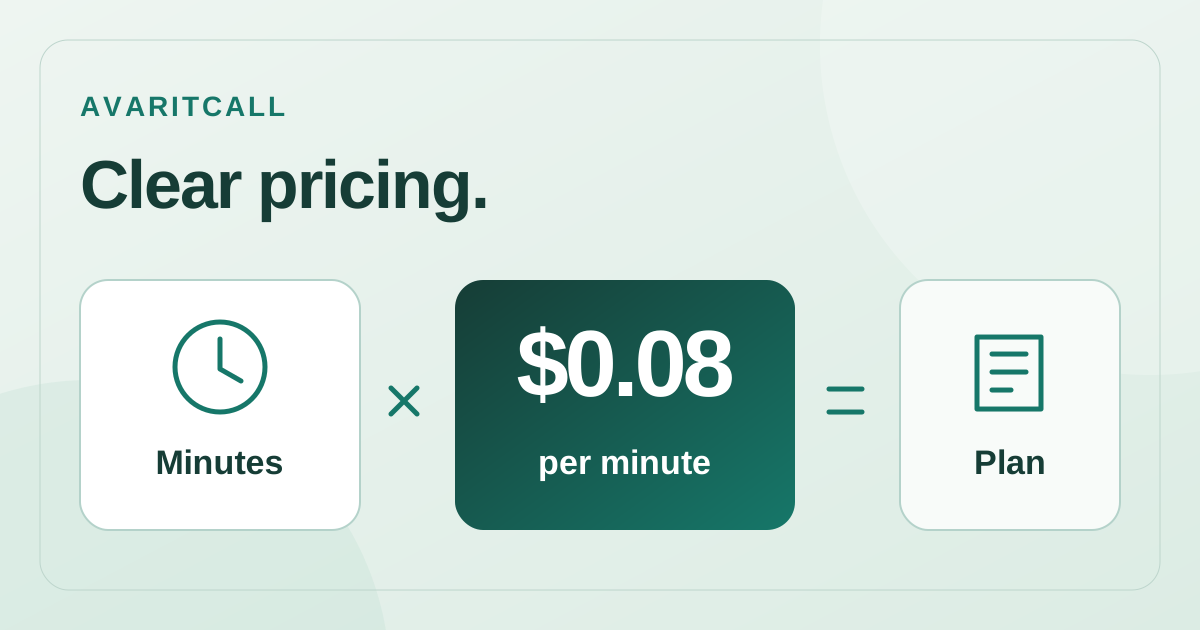
In AvaritCall this flow is configured from a single panel: listing information and handover rules (note, notification, call-back) are defined in the agent setup, calendar and WhatsApp/SMS connections are added; contacts, leads and conversation history are kept in the CRM inside the platform, and REST API and webhook documentation is available for external CRMs; while the agent is in the field, call results arrive as push notifications in the iOS app. Turn-taking, hesitation and interruption behaviour is specifically optimised for Turkish phone conversation. In Türkiye the average response latency is ~0.8 s (at Opus audio quality and without truncating context; the time from the moment the caller stops speaking until the agent begins its reply). No voice recording is made, only the text transcript is stored; the platform operates in compliance with KVKK and GDPR [8]. Pricing is pay-as-you-go: $0.08 per talk minute (STT, LLM and TTS included; reports, IVR and VAT extra), a $5 sign-up credit, no commitment [9].
Calls that should not be handed to the assistant
- Negotiation and price decisions: the answer to "Would 5 million do?" belongs to the owner and the agent, not the assistant. The assistant notes the offer; it does not respond to it.
- Contracts, deposits and the title deed process: anything with legal consequences is handed to a human; the assistant is not designed to produce final legal or financial decisions.
- Legal questions: on rent increase caps, eviction or condominium law, the assistant does not produce an answer; it notes the question and passes it to the agent.
- Noisy environments: recognition accuracy drops for callers phoning from a construction site or traffic; a call-back promise is safer on such calls.
- Emergencies: the assistant is not designed to replace an emergency line.
- Listing portals: automatic synchronisation with portals is not something this article promises; listing data is moved into the knowledge base through the office's own process.
- Concurrency: there is a limit to how many calls can be answered at the same time; very high concurrency falls under the enterprise plan, and busy campaign periods should be planned in advance.
Conclusion: Most of the phone traffic in a real estate office consists of repetitive, information-heavy, time-sensitive calls. A vendor study shows that returning to a lead within minutes markedly raises the odds of reaching and qualifying them [3]. An AI assistant set up with the right boundaries makes sure those calls are not missed, and leaves negotiation, contracts and the relationship to the agent. This article is not legal advice; regulations may change, and sources were accessed on 30 August 2026.
- [1]Türkiye'de 2025'te 1 milyon 688 bin 910 konut satıldı — Anadolu Ajansı (TÜİK bülteni aktarımı), 2026-01-20 (accessed: 2026-08-30)
- [2]Temmuz ayı konut ve iş yeri satış istatistikleri açıklandı — TRT Haber (TÜİK bülteni aktarımı), 2026-08-13 (accessed: 2026-08-30)
- [3]Lead Response Management Study — InsideSales.com / LeadResponseManagement.org (üretici araştırması, hakemli değil, tarihsiz) (accessed: 2026-08-30)
- [4]2025 Profile of Home Buyers and Sellers — Highlights — National Association of REALTORS (NAR), 2025-11-04 (accessed: 2026-08-30)
- [5]Taşınmaz Ticareti Hakkında Yönetmelik (RG 5.6.2018/30442) — T.C. Ticaret Bakanlığı (Aydın İl Müdürlüğü, resmî metin kopyası), 2018-06-05 (accessed: 2026-08-30)
- [6]Elektronik İlan Doğrulama Sistemi (EİDS) Yetki Doğrulama Uygulaması Hayata Geçirildi — T.C. Ticaret Bakanlığı, 2024-09-17 (accessed: 2026-08-30)
- [7]Aydınlatma Yükümlülüğü — Kişisel Verileri Koruma Kurumu (KVKK), 2018-01-29 (accessed: 2026-08-30)
- [8]AvaritCall — AI Info — AvaritCall (üretici sayfası) (accessed: 2026-08-30)
- [9]AvaritCall — Fiyatlandırma — AvaritCall (üretici sayfası) (accessed: 2026-08-30)