AvaritCall · Editorial team
WebRTC, SIP and PSTN: choosing a voice AI call path
Compare browser voice and telephone calls with a shared test plan. A practical guide to WebRTC, SIP and PSTN boundaries, media compatibility, user journeys and useful acceptance evidence.
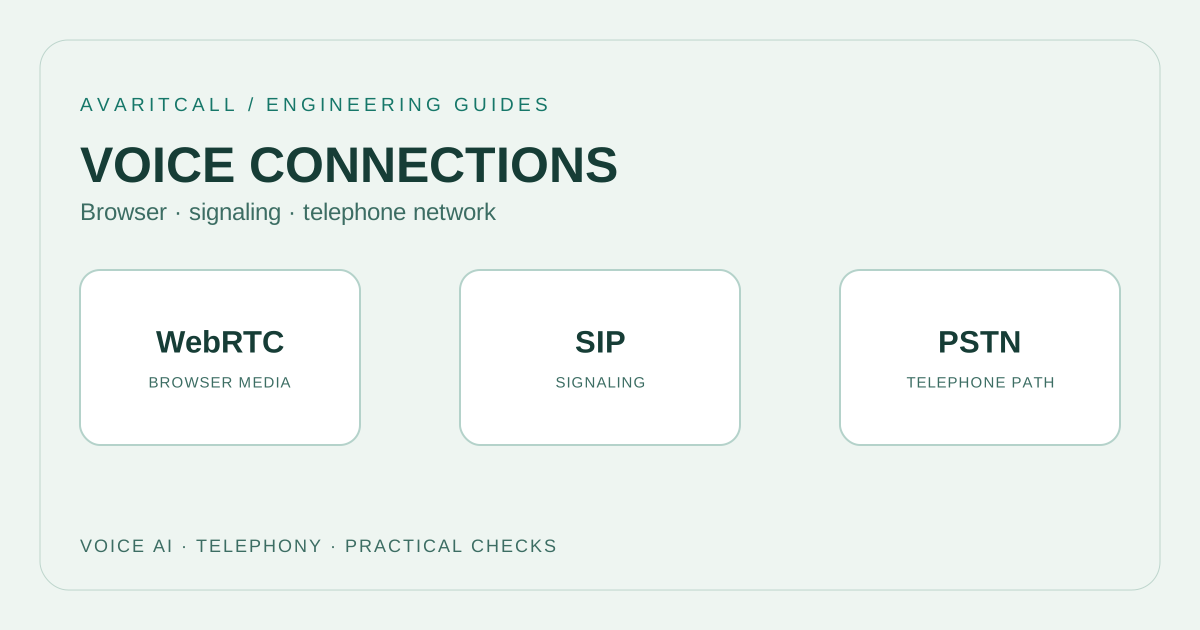
Short answer: evaluate a browser experience when users will speak from a web page, and a telephone path when they will dial a number. WebRTC, SIP and PSTN are not interchangeable codecs. They describe different layers and access methods. For voice AI, the decision starts with how the user enters a conversation and which boundaries it crosses. Write the access journey first, then assess session establishment and audio transport separately.
Separate the roles of WebRTC, SIP and PSTN
WebRTC combines protocols and APIs for real-time browser communication without prescribing a single application signaling protocol. [1] SIP signals session creation, modification and termination. [2] Interworking between PSTN and SIP can require mapping telephone signaling semantics. [3] Treat access, session control and media representation as distinct decisions. That makes it clear why “we use SIP” does not, by itself, explain microphone permissions or audio encoding.
Inspect the browser path from the user’s starting point
For a browser journey, first establish whether the visitor can use the intended microphone and output device. Design useful feedback for denied permission, a device moving to another application or a headset being disconnected. ICE uses candidates and connectivity checks to find a usable connection path. [4] To the user, what matters is whether the conversation can begin. Keep diagnostics separate from user guidance.
Inspect the telephone path through call states
Ringing, answer, busy, transfer and termination are separate acceptance states for telephone access. Match each state to the message the application gives the user. An answer indication alone does not verify that a two-way conversation has begun; listen in both directions. Where a bridge is involved, identify the boundary at which session control changes and the boundary at which media changes. Documenting signaling adaptation and codec conversion as one operation makes later failures harder to locate.
Compare access paths using the same task
| Area | Browser experiment | Telephone experiment |
|---|---|---|
| Start | Initiating from a page and selecting devices | Dialing a number and answering |
| Conversation | The same utterances and task | The same utterances and task |
| Continuity | Behavior after a device or network change | Behavior after hold or transfer |
| End | Hang-up control and user feedback | Remote hang-up and recorded state |
The matrix does not assume a winning path. The shared measure is whether the user completes the intended job. A browser test through a laptop headset and a telephone test in a noisy mobile environment compare more than protocols. Match the speaker, microphone conditions, task script and surroundings where possible. Record unmatched differences; assess access and speech intelligibility separately.
Make the experiment comparable and explainable
For a rescheduling task, use the same name, date expression and correction sentence. Observe connection establishment, first audible response, the ability to interrupt and task completion separately. When a stage fails, state whether the observation concerns access, media or task behavior. The team should be able to discuss the particular waiting point instead of describing the whole telephone channel as slow.
Include media security in the comparison. WebRTC endpoints must use SRTP and SRTCP for media. [5] Assess the telephone path’s protection scope on each leg separately. Do not interpret a connection icon as proof about the entire route. Choose format and state fields needed to explain the observation instead of filling test records with private addresses or conversation content.
Hypothetical example: two hotel access channels
Imagine a hotel considering a website conversation button alongside a dialable number. The team performs the same “change my reservation date” task through both channels. A denied browser microphone permission leads to guidance about alternative access. On the telephone, the team checks whether speech continues after employee transfer. Both paths apply the same task rule when a guest corrects a date; changing the access protocol should not silently change the business behavior.
The results contain the completed task, failing stage and test conditions together. A browser network problem and missing audio after telephone transfer become different follow-up investigations. The apparently identical complaint “I cannot speak” can then produce specific findings with different causes. Reuse the task set for later comparisons.
Deployment checklist
- Write the start, permission, answer and termination steps.
- Map signaling and media paths separately.
- Verify selected codecs and security scope at each boundary.
- Compare channels with the same speaker, task and correction phrases.
- Observe hold, transfer, device changes and connection loss.
- Record access, media and task success as separate outcomes.
Frequently asked questions
Does WebRTC make SIP unnecessary? That depends on access and session-control needs. Evaluate web signaling separately from the protocol used at a telephone boundary. Browser functionality does not automatically determine the capabilities of the other connections.
Will a voice model that works in a browser behave identically on the phone? Verify it using the same task and comparable audio conditions. Devices, media conversions and user behavior can differ. Changing the model and access route together obscures the reason for a result.
Is one channel enough? Examine users’ access habits and their tasks. Before adding channels, define each channel’s acceptance conditions and the alternative journey for cases it cannot handle.
- [1]RFC 8825: Overview: Real-Time Protocols for Browser-Based Applications — IETF / RFC Editor, 2021-01 (accessed: 2026-10-01)
- [2]RFC 3261: SIP: Session Initiation Protocol — IETF / RFC Editor, 2002-06 (accessed: 2026-10-01)
- [3]RFC 3398: Integrated Services Digital Network (ISDN) User Part (ISUP) to Session Initiation Protocol (SIP) Mapping — IETF / RFC Editor, 2002-12 (accessed: 2026-10-01)
- [4]RFC 8445: Interactive Connectivity Establishment (ICE): A Protocol for Network Address Translator (NAT) Traversal — IETF / RFC Editor, 2018-07 (accessed: 2026-10-01)
- [5]RFC 8834: Media Transport and Use of RTP in WebRTC — IETF / RFC Editor, 2021-01 (accessed: 2026-10-01)