AvaritCall · Editorial team
How jitter and packet loss affect voice AI
Broken audio and slow replies can have different causes. Separate jitter, latency and packet loss, then use buffer behaviour, FEC, PLC and RTCP evidence to diagnose the call.
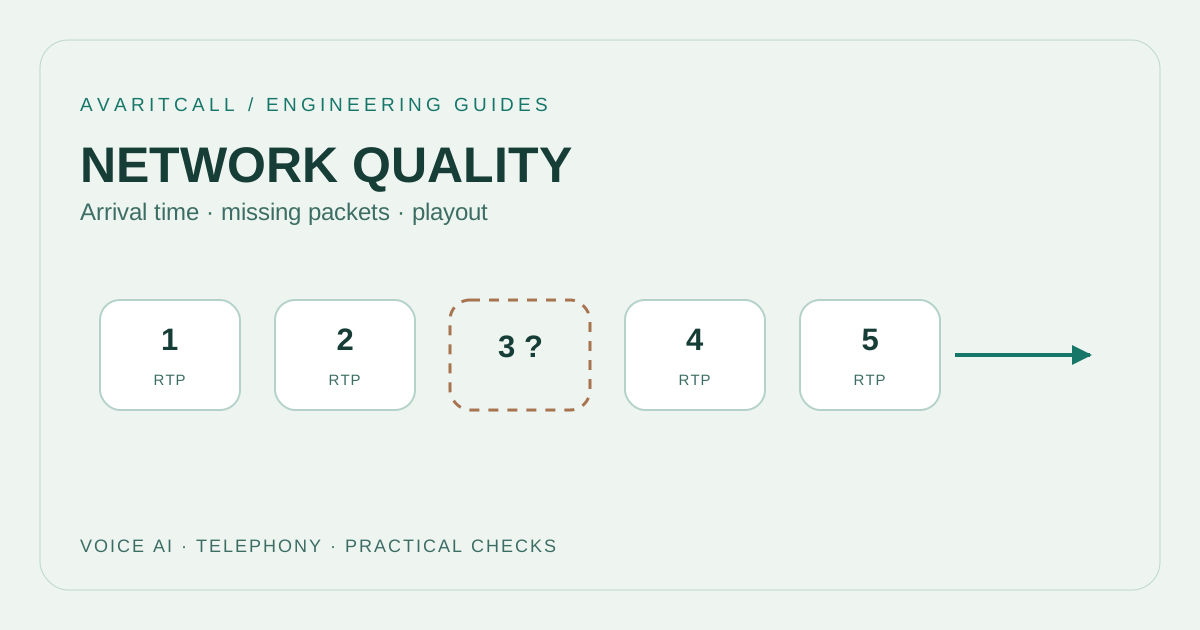
Jitter, packet loss and latency are different problems, and a setting that improves one can worsen another. Start by locating the affected call direction and stage. Examine packet traces, playable receiver audio and application response timing together. Use a repeatable test script to assess each change against the same words and conversation timing.
1. Separate latency, jitter and loss
Latency is packet travel time; jitter is variation in that time; loss means an expected packet does not arrive. A jitter buffer smooths irregular arrivals. [1] When someone reports “bad audio”, first classify the symptom: is speech breaking up, are people talking over each other, or does only the assistant response start late? One label cannot explain all three situations.
Treat missing syllables in caller speech and interruptions in assistant output as separate events. Clean audio in one direction does not prove the other direction is healthy. Record the call identifier, affected direction, symptom onset and observation point. This makes it easier to avoid linking a network change to a model or speech detection change without evidence.
2. Give the jitter buffer a time budget
A longer playout wait can make some late packets usable, but adds conversational delay. [1] Judge a buffer change by more than fewer dropouts. When does the reply begin after the caller finishes? How promptly does playback stop when the caller interrupts? How are natural pauses interpreted? Include those behaviours in the acceptance criteria for the service.
Keep the codec, packet duration and test script fixed. Document a baseline, then change one setting in separate trials. Inspect troublesome moments rather than just an average: busy-period failures can disappear in an all-day summary. Report any improvement from a larger buffer alongside its additional waiting cost.
3. Distinguish FEC, PLC and retransmission
Opus in-band FEC can carry information about the preceding packet in the next packet; using it requires access to that packet. [4] PLC estimates missing audio. [5] Retransmission must arrive before the playout deadline. [6] Evaluate actual receiver use and timing rather than treating an enabled feature flag as evidence of successful recovery.
| Method | What to check in a trial | Success criterion |
|---|---|---|
| FEC | Can the required next packet be used in time? | Do fewer missing syllables justify the response wait? |
| PLC | How does concealed speech sound and transcribe? | Are names and numbers accurate as well as fluent? |
| Retransmission | Does recovered data reach the playout deadline? | Does extra traffic deliver useful audio? |
An enabled flag does not mean every missing sound was recovered. A call can seem understandable while an important booking time or order quantity is transcribed incorrectly. Include similar sounding names, short numbers and negation in your test script, and mark these results separately. A general fluency score can otherwise hide a mistake that changes the requested action.
4. Read RTCP evidence in context
In RTCP reception reports, fraction lost covers the reporting interval, cumulative loss starts at reception, and jitter uses RTP timestamp units. [2] Where supported, RTCP XR separately provides receiver discard, burst and buffer information. [3] Verify a monitoring tool’s field definitions before comparing numbers displayed on different dashboards.
Match reports to call direction and time interval. Reading jitter as milliseconds without conversion, or using whole-call loss to explain one brief interruption, can lead to the wrong decision. If a receiver cannot use packets because they arrive late, the number of packets received on the network is insufficient evidence by itself. Where available, inspect late discard counters and playout audio for the same event.
5. Investigate a hypothetical reception call
A caller says “Tuesday, fourteen thirty”, but the transcript reads “Tuesday, four thirty”. The team first repeats the same sentence over a clean connection. Next, it aligns audio input, packet events and recognised text from the problematic trial. The purpose is to identify where the missing syllable disappears, rather than declaring a model fault before examining the evidence.
The second trial changes only the buffer target. If the word improves while the response slows, record distinct findings. A third trial changes load. Keep the sentence, direction and evaluation method consistent. Document the conditions where the improvement repeats and those where it disappears.
6. Use a checklist before making changes
- Select the affected direction and interval; do not stop at a whole-call average.
- Use the same event identifier for packets, decoded audio and recognised text.
- Change one setting at a time; record the previous value and reversal step.
- Evaluate names, quantities, dates and negation separately.
- Check response onset and interruption handling alongside audible dropouts.
- Define acceptance criteria for the use case; do not prescribe one jitter or loss threshold for every network.
Frequently asked questions
Does zero packet loss guarantee clean audio? No. Investigate received but unusable late packets, local audio processing and application behaviour too. A zero value cannot settle the question without knowing which counter produced it.
Should every call use a larger buffer? No. Evaluate interruptions, critical word accuracy and conversational flow in the same trial. The objective is to demonstrate an acceptable balance for the chosen service.
- [1]Understanding Jitter in Packet Voice Networks (Cisco IOS Platforms) — Cisco, 2006-02-02 (accessed: 2026-10-01)
- [2]RFC 3550: RTP: A Transport Protocol for Real-Time Applications — RFC Editor / IETF, 2003-07 (accessed: 2026-10-01)
- [3]RFC 3611: RTP Control Protocol Extended Reports (RTCP XR) — RFC Editor / IETF, 2003-11 (accessed: 2026-10-01)
- [4]RFC 7587: RTP Payload Format for the Opus Speech and Audio Codec — RFC Editor / IETF, 2015-06 (accessed: 2026-10-01)
- [5]Troubleshooting QoS Choppy Voice Issues — Cisco, 2006-02-02 (accessed: 2026-10-01)
- [6]RFC 4588: RTP Retransmission Payload Format — RFC Editor / IETF, 2006-07 (accessed: 2026-10-01)