AvaritCall · Editorial team
Streaming STT: when is a transcript ready to use?
Streaming transcripts can change, and final flags have provider-specific scope. Separate displaying partial results, assembling finished segments and confirming important dates or numbers.
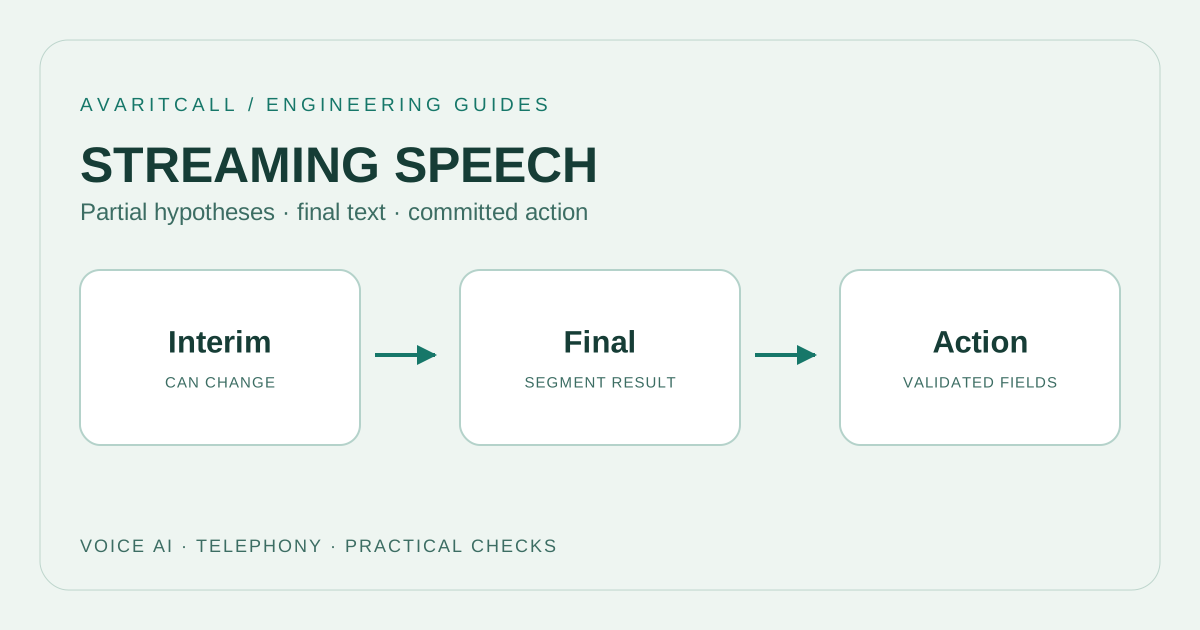
The first text displayed by streaming STT is not automatically the final text on which to act. Read the provider’s definition to determine whether a result is provisional or finalized for a particular audio segment. Then decide when the application has enough information to use it. A booking date or order quantity needs a separate validation decision and, where appropriate, confirmation from the caller.
1. Treat interim results as an updating draft
Amazon Transcribe documents that streaming results can change as more context arrives. [2] Appending every new result to the previous text is therefore not a sound assumption. Determine whether an event updates the same segment or supplies a different one. Updating a visible draft and assembling completed segments are separate operations, and the test should distinguish them.
If you display interim text, make its provisional status clear. Showing a date that subsequently changes is different from starting an operation based on that date. Do not present a preview as an action status. Record the first visible text, last visible text and value actually used separately, so the investigation can distinguish a recognition problem from premature application use.
2. Read finality at the provider’s documented scope
| Provider | Documented distinction | Further application question |
|---|---|---|
| Google Cloud STT | isFinal finalizes that audio portion; stability estimates whether an interim result will change. [1] | Does the portion contain all the information expected? |
| Amazon Transcribe | IsPartial marks segment status; with partial-result stabilization enabled, Stable=true marks word or punctuation items that will no longer change, while Stable=false marks items that may change. [2] | Are item status and completion of the whole request being confused? |
| Deepgram (Nova) | is_final marks a finalized segment; speech_final marks an endpointing boundary. [3] | Must multiple finalized segments be collected? |
Do not interpret Google’s stability as word accuracy confidence; it estimates resistance to change. [1] The table does not make these providers’ fields interchangeable. Document their meaning for the interface, version and mode being used. Combining different scopes under one “final” variable can leave the next engineer uncertain about which information has actually been finalized and which decision remains open.
3. Make a separate decision for numbers and dates
A finalized recognition segment is not the same as correct business information. Context determines whether “Tuesday, fourteen” describes a time or calendar detail. Keep the raw transcript before recording an interpreted field separately. Check whether the task’s expected meaning is complete rather than finalizing a date, time or quantity merely because displayed text stopped changing.
Create an original test where the preview shows “fourteen” and a later result shows “fourteen thirty”. Identify the step affected by premature use: did only a preview change, was the spoken readback incorrect, or did an operation begin? For important information, a short, clear readback gives the caller a visible opportunity to correct the interpretation.
4. Test assembly, repetition and interruption separately
Deepgram documents that multiple is_final segments can arrive before speech_final. [3] Test this by reading one long utterance with different pauses. Obtaining the complete text and obtaining the most recent event need not be the same operation. Evaluate assembly against documented segment boundaries and the timeline of the same trial, rather than assuming the last message includes every earlier word.
Also check whether processing the same result again duplicates text or an operation. Distinguishing call, segment and update context can help. If the connection breaks, do not automatically present the latest provisional text as a finalized result. Define the appropriate behaviour for incomplete information: listen again, ask the caller to repeat, or indicate that the information remains incomplete.
5. A hypothetical time confirmation trial
A caller says “tomorrow fourteen … thirty, sorry, fifteen”. The first draft looks like fourteen, then a longer expression emerges, and finally the caller explicitly corrects it. Check three things: does the draft update correctly, are completed segments assembled correctly, and does the interpreted time incorporate the correction? Recognition finality is not a reason to ignore something the caller says subsequently.
The second trial uses the same sentence with different pauses. In the third, the connection ends before the result stream finishes. Compare visible text, completed segments, interpreted field and spoken readback in each trial. The goal is to identify when information is sufficient for action, rather than convert every event into an operation. A concise confirmation question can recover the conversation when the time remains ambiguous.
6. Use a streaming transcript checklist
- Distinguish an update to an interim segment from a new segment.
- Record the provider’s field meaning and the result’s scope.
- Separate raw text, assembled text and the interpreted field.
- Test dates, times, numbers and subsequent corrections.
- Check that repeated events do not duplicate text or operations.
- Handle incomplete results explicitly when the stream breaks.
- Read back and confirm important information where needed.
Frequently asked questions
Does final mean the entire request was understood correctly? No. Establish which audio portion the provider finalized, then evaluate the business information’s meaning and completeness.
Should interim text never be used? It can help with previews and reversible preparation. Do not apply the same rule to operations based on important dates or numbers; keep result status and intended use separate.
- [1]StreamingRecognitionResult — Cloud Speech-to-Text V2 — Google Cloud, 2025-10-23 (accessed: 2026-10-01)
- [2]Streaming and partial results — Amazon Web Services (accessed: 2026-10-01)
- [3]Configure Endpointing and Interim Results — Deepgram (accessed: 2026-10-01)